← floriankaempf.com

Chemosensation · olfactory channels · maleCNS v1.0 × FlyWire 783

Fly odour ORN figure

Five olfactory channels carry fly odours. In the male brain they hold more receptor neurons than any other olfactory channel, and they reach sexually dimorphic targets at the first synapse. What they do with their output, they do in both sexes alike.

maleCNS v1.0FlyWire 78353 shared ORN types no synapse threshold5 channels against 48 nulls

Findings

Three results and two negatives

PanelResult
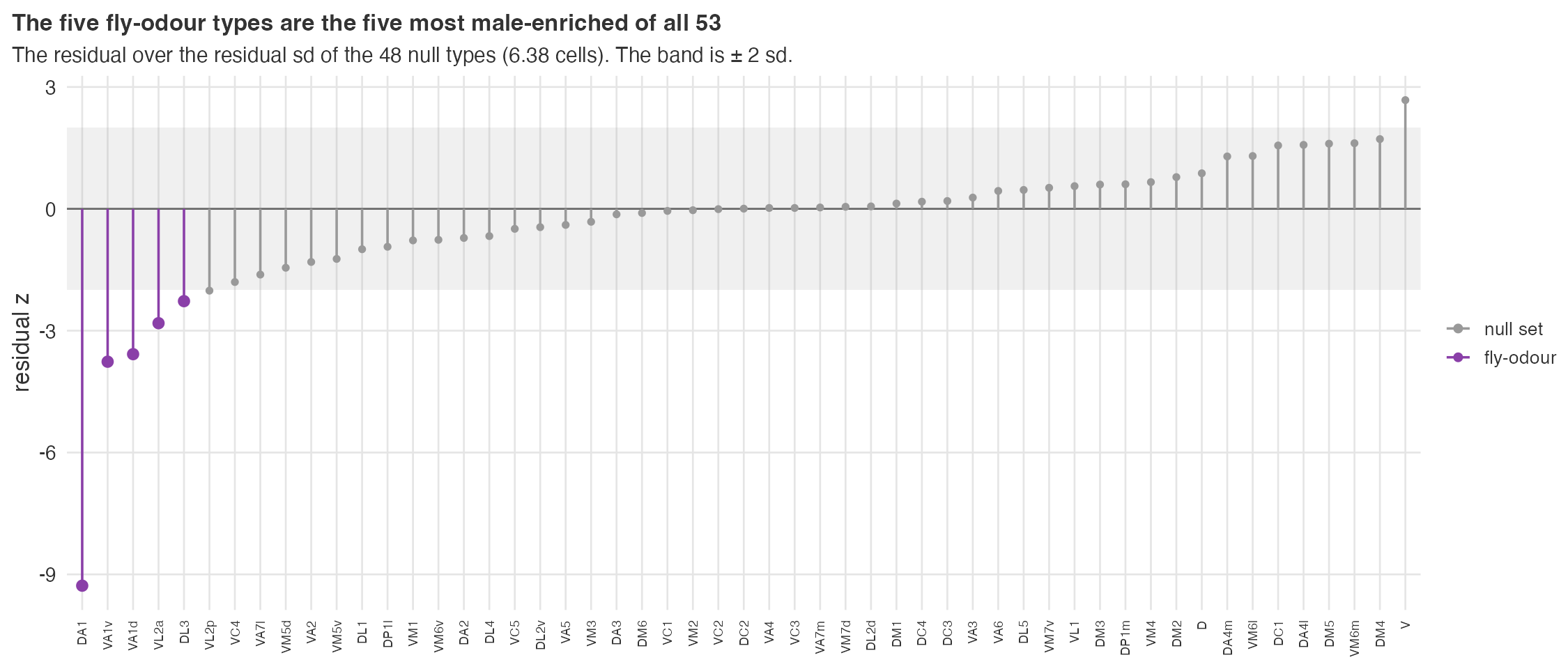
A The five fly-odour glomeruli are the five largest ORN populations of the male brain, ranks 1 to 5 of 53. Against a line fitted to the other 48 types they are also the five most male-enriched. DA1 falls 9.3 residual sd below that line.
A3 They hold a larger share of the male ORN output than of the female. DA1 takes 8.3 % of the male ORN output against 3.8 % of the female. DL3 is the exception: on output share it is an ordinary channel in both sexes.
B One synapse downstream, four of the five carry the largest dimorphic fractions of all 53 types. VA1v sends 9.0 % of its output to dimorphic partners and VA1d 6.6 %, against a best null of 0.6 %. DL3 sends none.
C1 A fly-odour ORN contacts no more partner types than an ordinary ORN, and no more in one sex than in the other. The two sexes differ by under one partner type once the count is corrected for how completely each cell is traced.
C2 The two sexes spread the output across partners in the same shape. By the area between the male and the female curve, the five sit at or below the median of all 53.

Method

Two connectomes, 53 shared ORN types

The male is maleCNS v1.0 and the female is FlyWire 783. The olfactory receptor neurons are the cells that each dataset classes as olfactory. The same 53 ORN types occur on both sides and no type is present on one side only. Neither side carries a synapse threshold.

SideDatasetORN cellsTypesOut-edgesOut-syn / cell
MalemaleCNS v1.02 63553234 487517
FemaleFlyWire 7832 2765398 022157

The five channels

DA1, VA1v, VA1d, DL3 and VL2a. DA1 and DL3 carry cVA, VA1v and VA1d methyl laurate, VL2a phenylacetic acid.

The null set

The 48 ORN types that are not fly-odour types. Not a shuffle and not a random draw. Every fit on this page is fitted on those 48, and every ranking is a ranking against them.

Why the counts are corrected

A male ORN carries 517 output synapses and a female ORN 157. That is a property of the two reconstructions, not of the fly. Panels that count synapses use shares, and panels that count partners are rarefied.

Panel A

The male devotes more neurons to fly odours

A1 · cells per fly-odour glomerulus
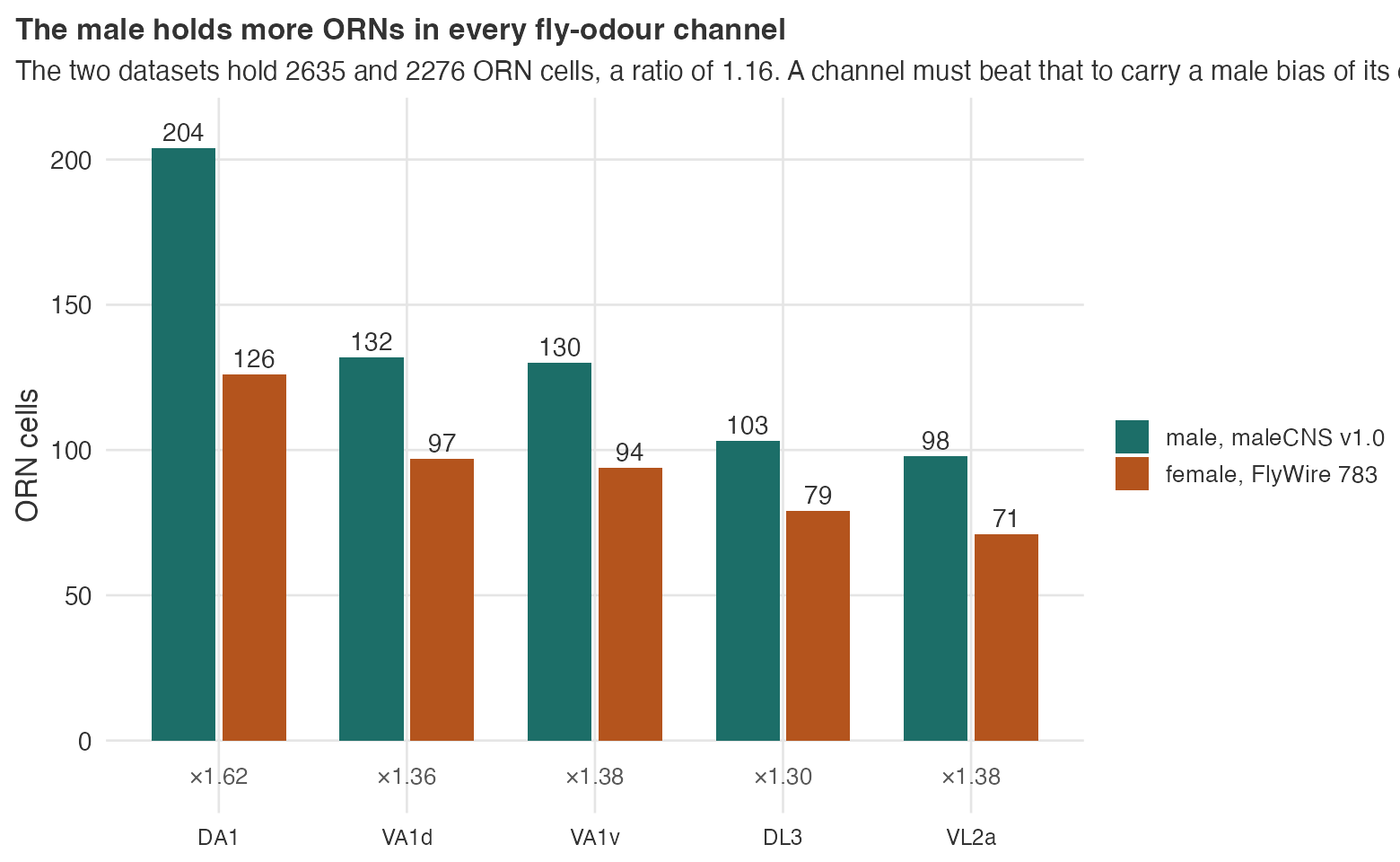
Paired bars of ORN cell counts for the five fly-odour glomeruli, male against female.
The male holds more cells in all five. The two datasets hold 2 635 and 2 276 ORN cells in total, a ratio of 1.16, so a channel must beat 1.16 to carry a male bias of its own. All five do, and DA1 reaches 1.62.

A1′ · the same census for all 53 ORN types
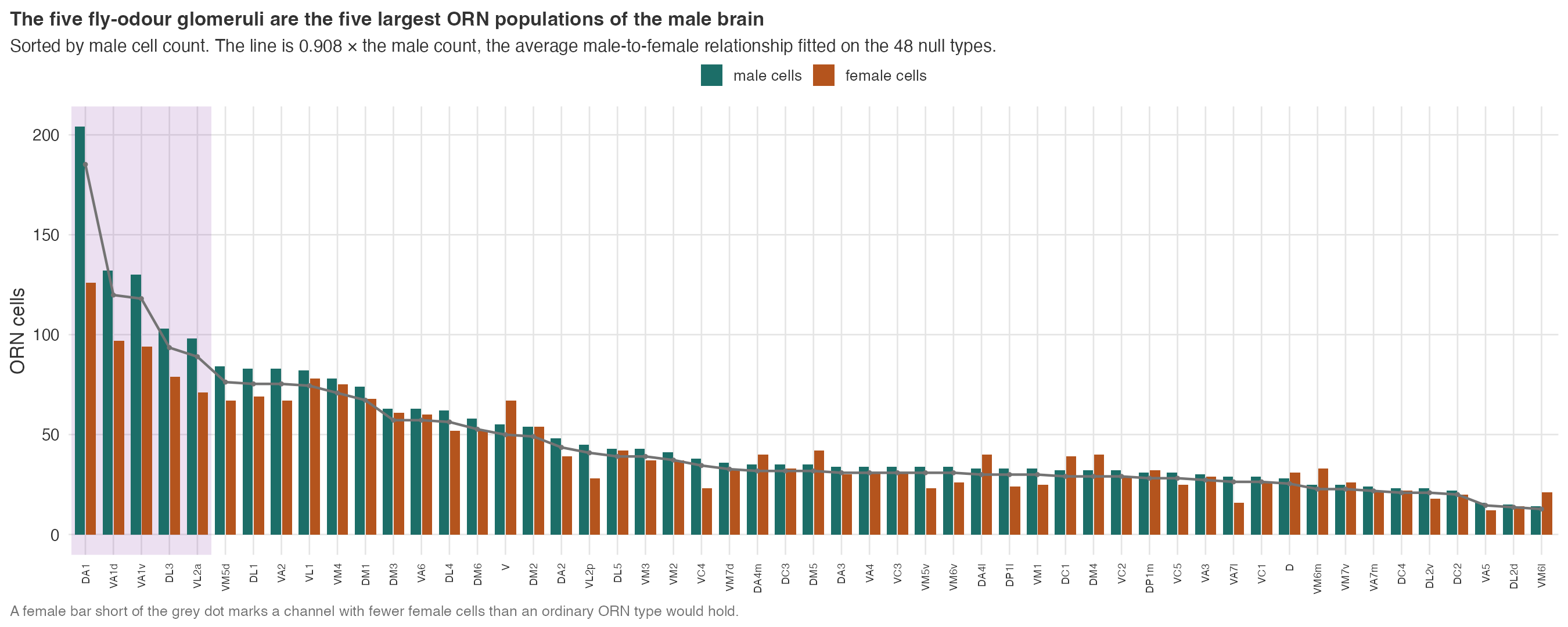
Paired male and female cell counts for all 53 ORN types, sorted by male count, with the average line over the female bars.
The five fly-odour glomeruli are the five largest ORN populations of the male brain, so their columns stand together at the left. Sixth place is VM5d with 84 cells against VL2a’s 98. The grey line is 0.908 × the male count, the average male-to-female relationship fitted on the 48 null types. A female bar short of the grey dot marks a channel with fewer female cells than an ordinary ORN type would hold.

A2 · all 53 types against the average line
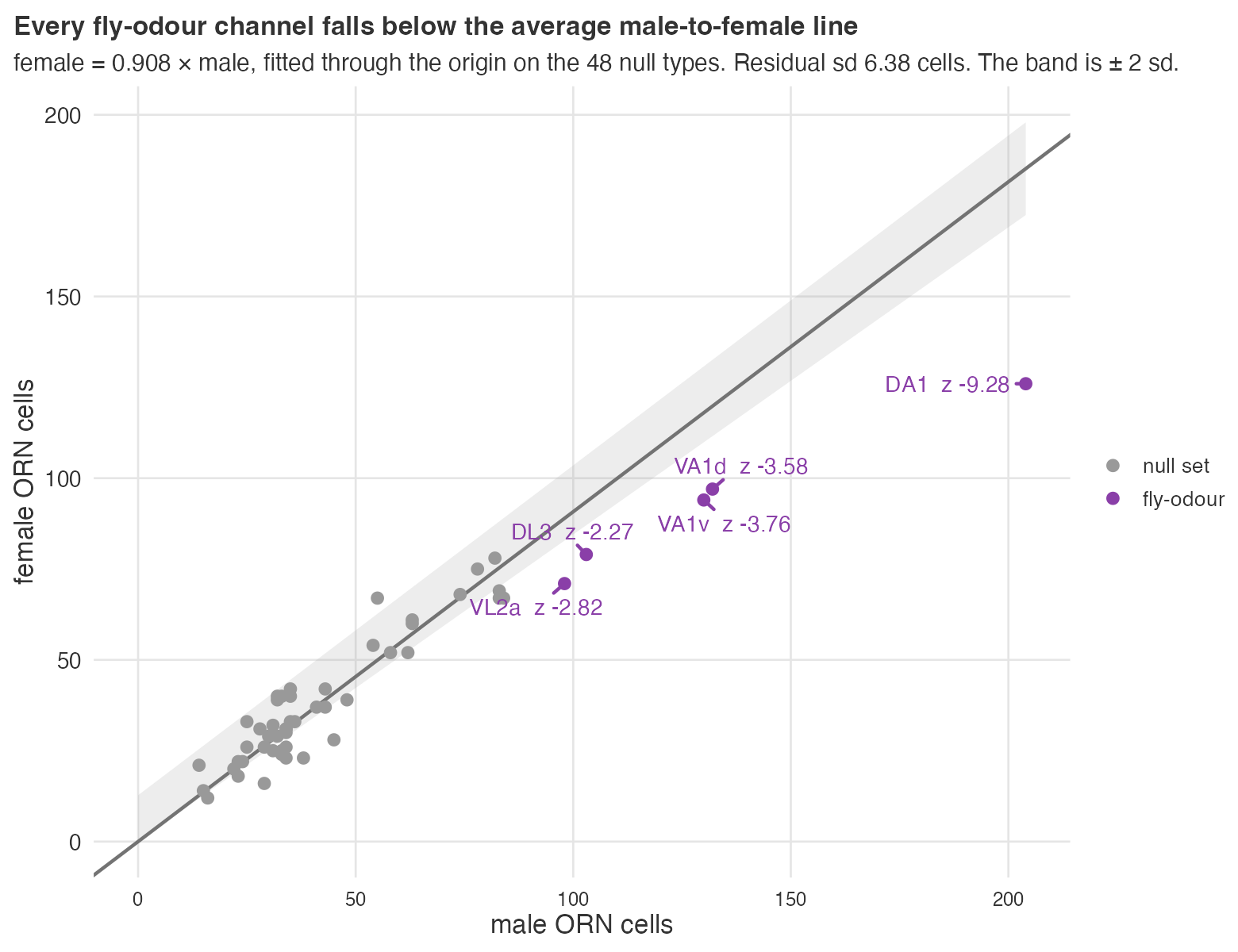
Female against male ORN cell count for all 53 types, with the fitted line, its two sd band and the five fly-odour types labelled.
Each point is one ORN type. The line is fitted through the origin on the 48 null types alone: female = 0.908 × male, residual sd 6.38 cells. All five fly-odour types fall below it, and DA1 falls 9.3 sd below, outside anything the null set reaches.

A2′ · distance from the line, ranked

Residual z for each of the 53 ORN types, ranked, with the five fly-odour types marked.
The same fit read as one number for each type. The five fly-odour types are the five most negative of all 53. The most negative null type is VL2p at −2.0, against DA1 at −9.3.

A3 · share of all ORN output synapses
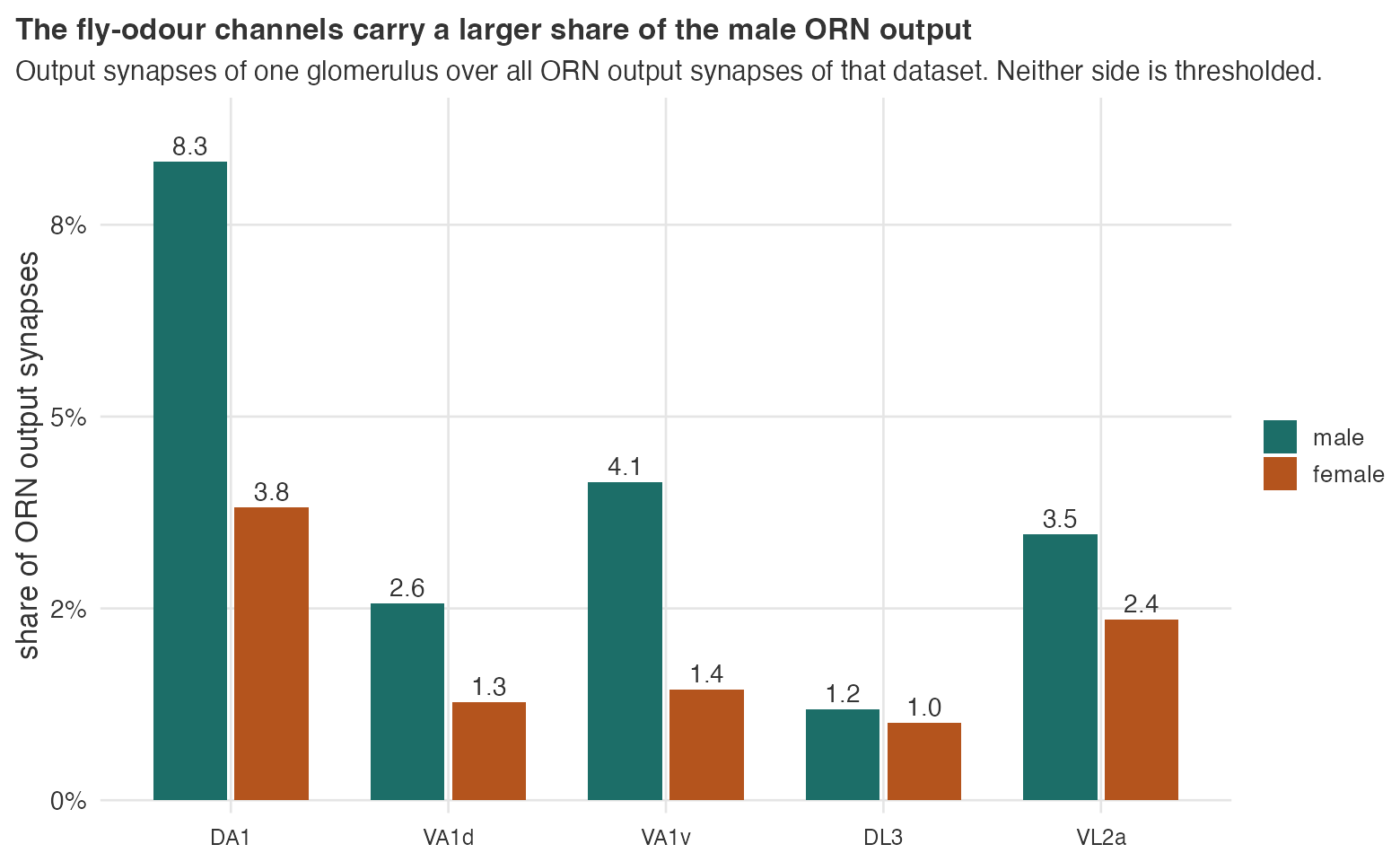
Share of all ORN output synapses for the five fly-odour glomeruli, male against female.
Output synapses of one glomerulus over all ORN output synapses of that dataset. The share is what makes the two reconstructions comparable. DA1 holds 8.3 % of the male ORN output against 3.8 % of the female, a wider gap than its cell count alone gives.

A3′ · the same share for all 53 types
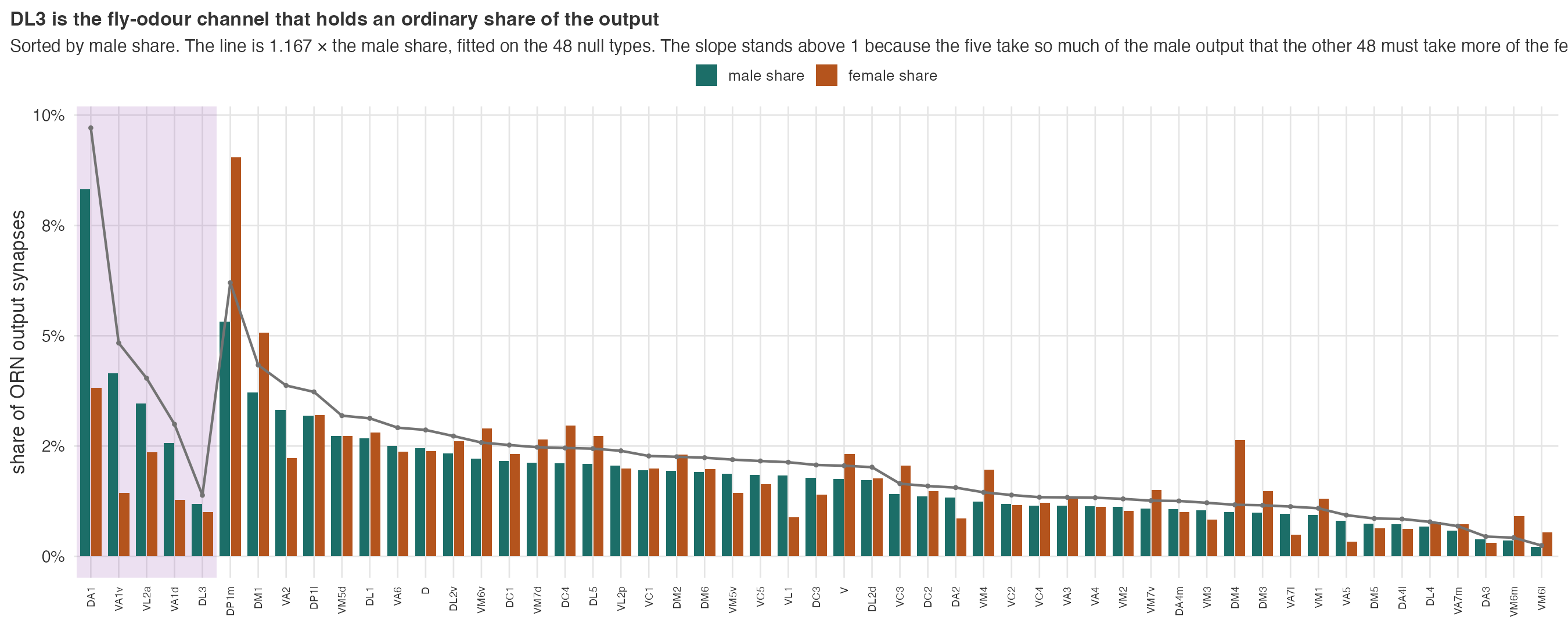
Share of all ORN output synapses for every ORN type, sorted by male share, with its own average line.
Sorted by male share: DA1 8.32 %, DP1m 5.32 %, VA1v 4.14 %, DM1 3.72 %, VL2a 3.46 %. The line is female share = 1.167 × male share, fitted on the 48 nulls. Its slope stands above 1 because the five take so much of the male output that the other 48 must take proportionally more of the female, which makes the line a harder test and not an easier one. Residuals: DA1 −8.85, VA1v −5.09, VA1d −2.57, VL2a −2.52. DL3 reaches only −0.56 and holds an ordinary share in both sexes, so the DA1 result is not a general cVA result.

Panel B

The dimorphic split starts at the first synapse

For each ORN type, take its direct postsynaptic partners and ask what share of the output reaches a type the male connectome marks dimorphic or male-specific. One hop.

B · output synapses onto dimorphic partners
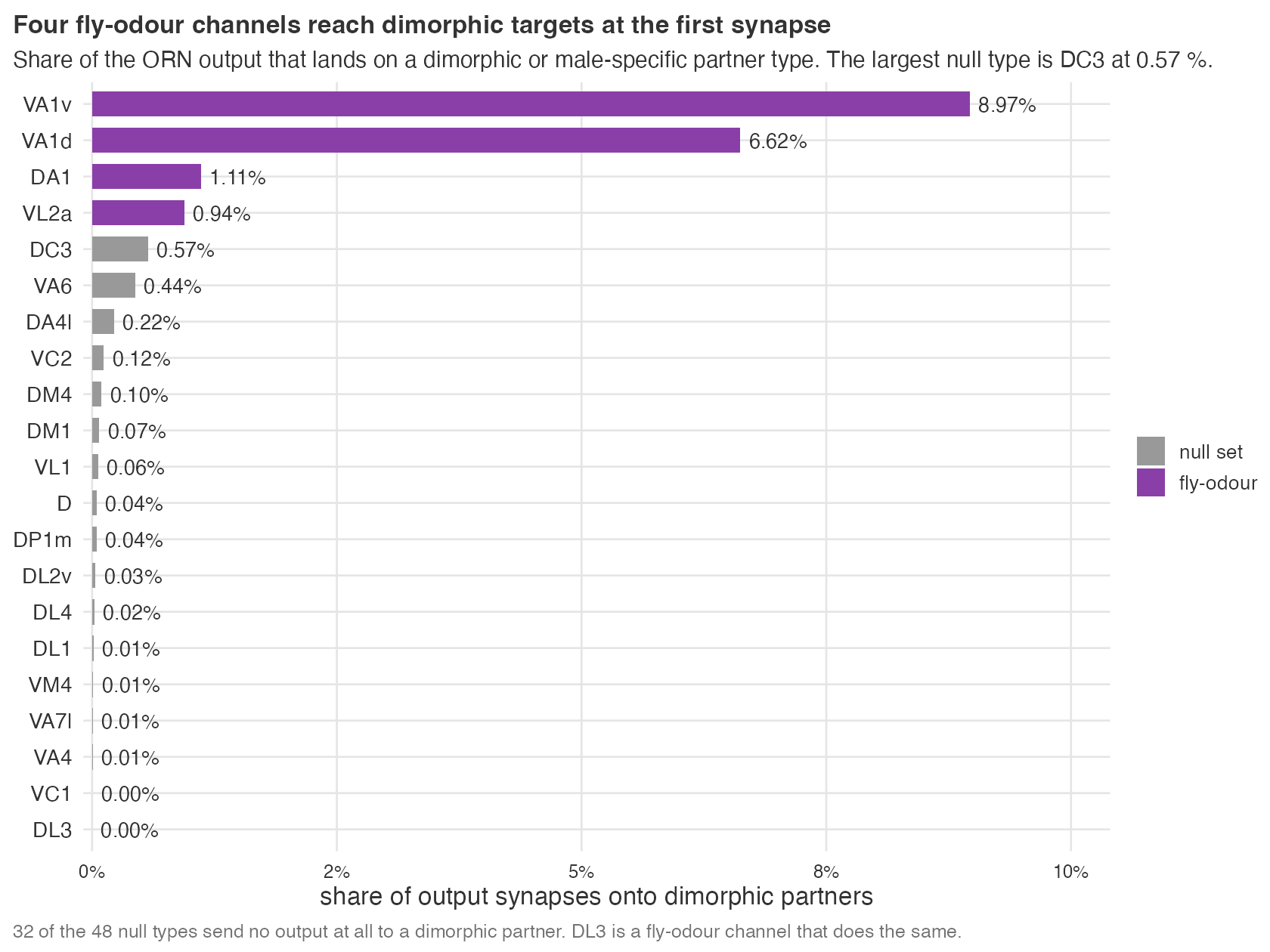
Ranked share of ORN output synapses that reach a dimorphic partner type.
32 of the 48 null types send nothing at all to a dimorphic partner, and the largest of them is DC3 at 0.57 %. VA1v at 8.97 % and VA1d at 6.62 % stand more than ten times above it. DA1 and VL2a clear every null type by a narrower margin. DL3 is zero across all 60 of its partner types. Finding 9 % of the VA1v output already on dimorphic targets puts the split at the first synapse and not deep in the brain.

B′ · the two scores

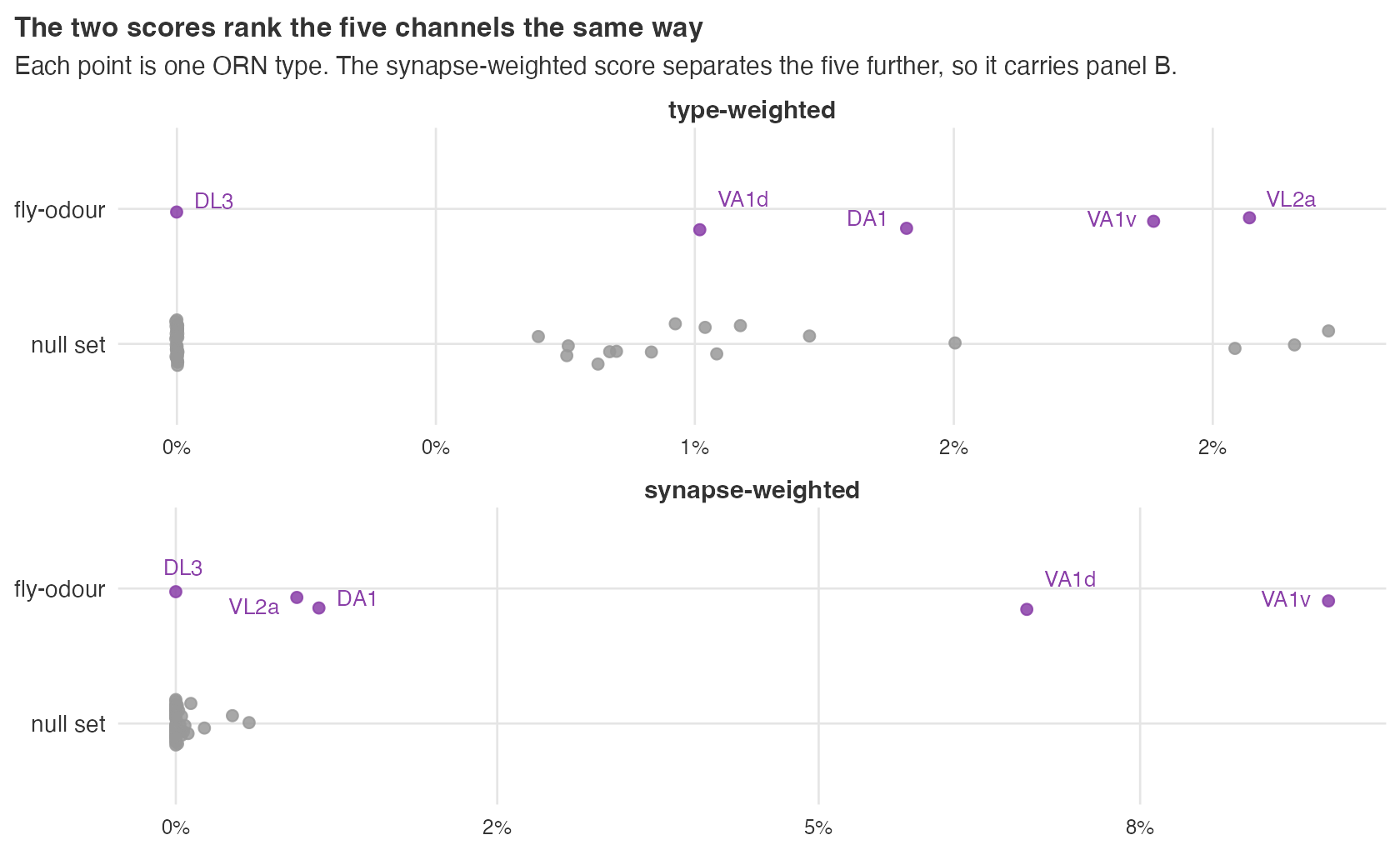
Type-weighted and synapse-weighted dimorphic fraction for every ORN type.
A channel can speak to many dimorphic types with few synapses, or to one dimorphic type with many. The two scores separate those cases and rank the five the same way. The synapse-weighted score separates them further, so it carries panel B.

Panel C

What the two sexes do with the output is the same

The number of partner types a cell reaches is a species-richness count, and richness rises with sample size. A male ORN carries 3.3 times the output synapses of a female ORN, so it reaches more partner types for arithmetic reasons alone. Rarefaction removes that: for each cell, the expected number of distinct partner types in a random sample of a fixed number of its output synapses. The form is exact and needs no simulation, E = ∑ (1 − C(S−w, N) / C(S, N)) over the partner types of that cell.

C1 · distinct partner types for one ORN, raw
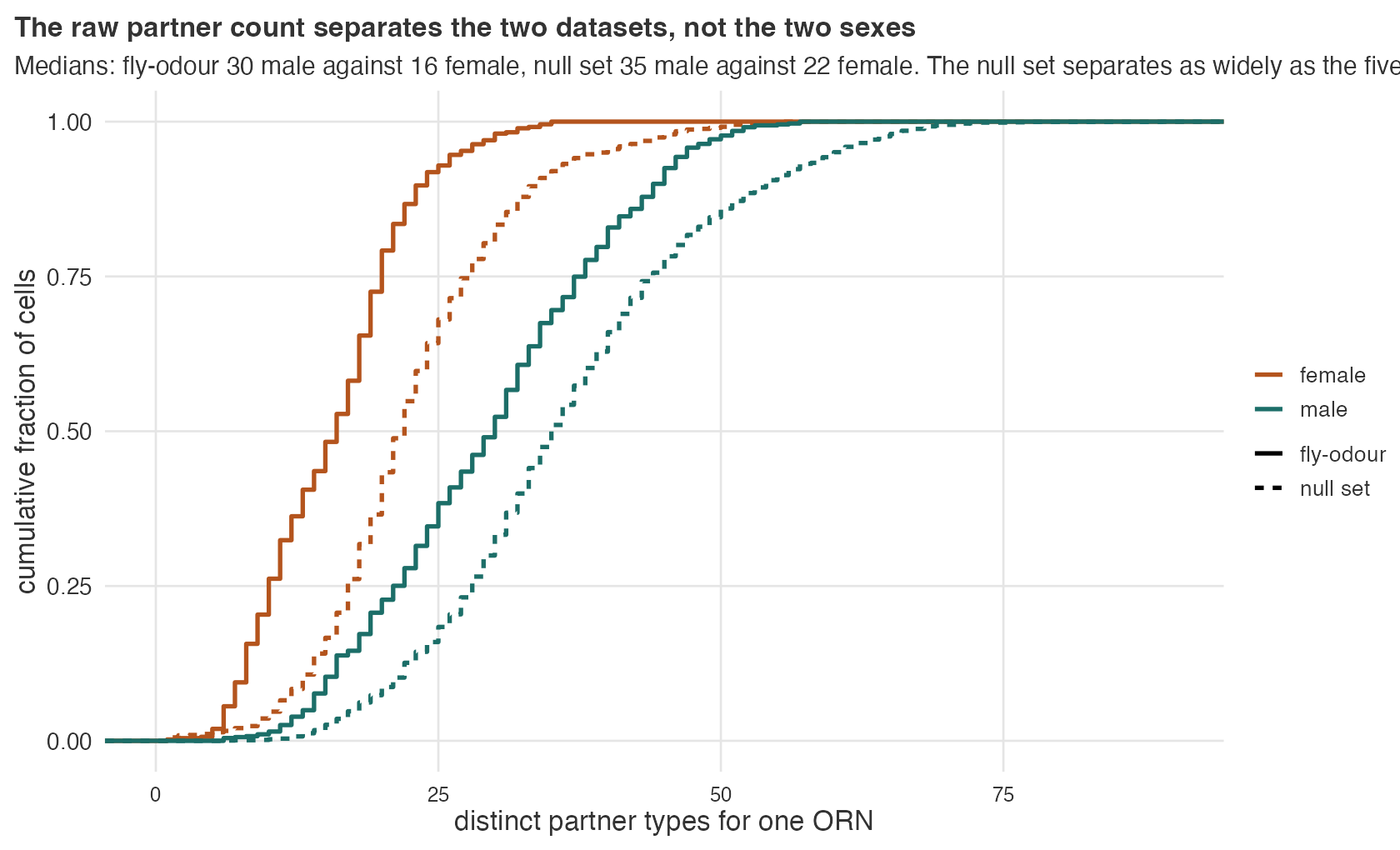
Cumulative distribution of the raw number of distinct partner types for one ORN.
Medians: fly-odour 30 male against 16 female, null set 35 male against 22 female. The null set separates as widely as the five do, which marks the gap as a property of the two reconstructions and not of the channels.

C1′ · the same count, rarefied to 50 output synapses
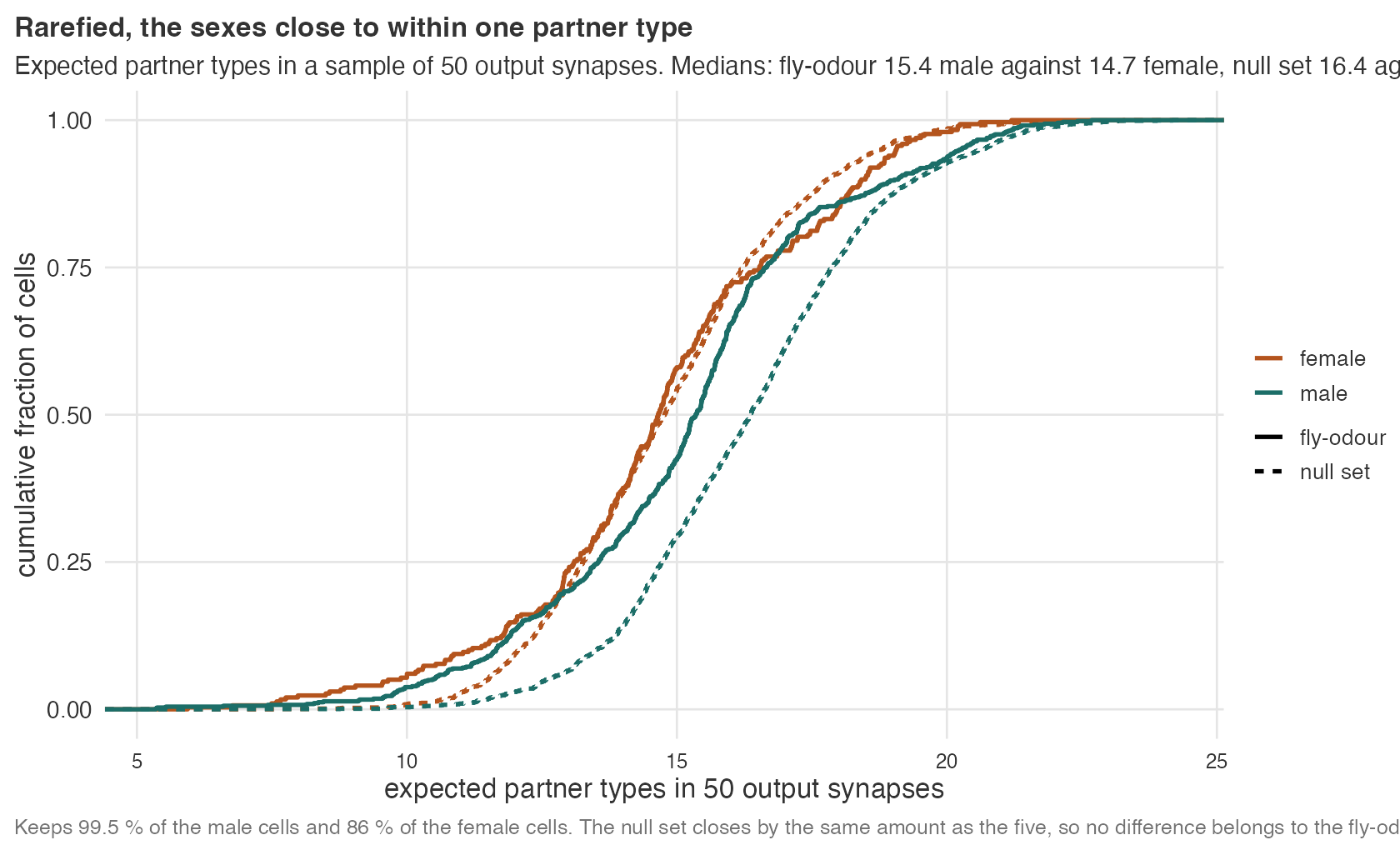
Cumulative distribution of the rarefied partner richness for one ORN.
Rarefied to N = 50, which keeps every male cell and 86 % of the female cells. The medians close from 30 against 16 to 15.4 against 14.7, and the null set closes to 16.4 against 14.8. Per glomerulus the Kolmogorov-Smirnov tests still reject, DA1 at p = 2.5e-11, but the difference they reject is under one partner type and the null set carries it too. Partner richness holds no difference specific to the fly-odour channels.

C2 · rank abundance, one plot per glomerulus
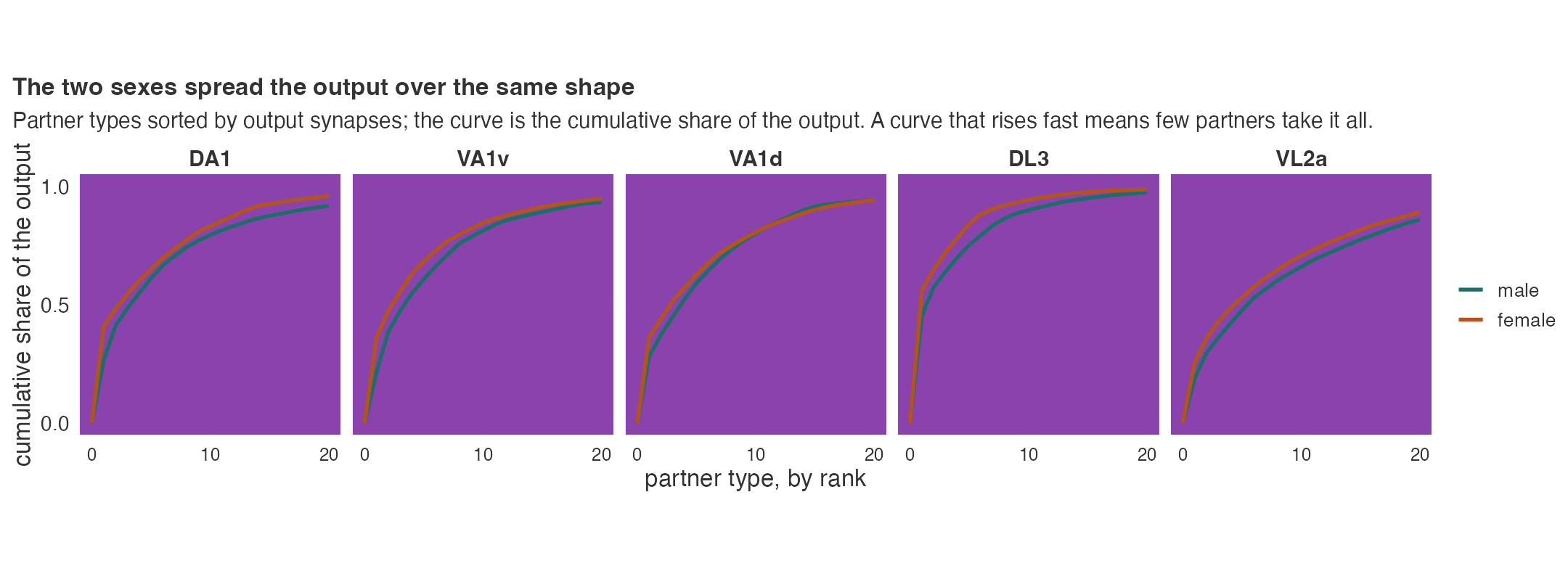
Rank abundance curves of the ORN output for each fly-odour glomerulus, male against female.
Partner types sorted by output synapses; the curve is the cumulative share of the output. A curve that rises fast means few partners take it all. DL3 is the most concentrated of the five: its strongest partner takes 45 % of the male output and 56 % of the female. VL2a is the most spread, at 19 % and 25 %.

C2′ · every type, ordered by the male-female gap
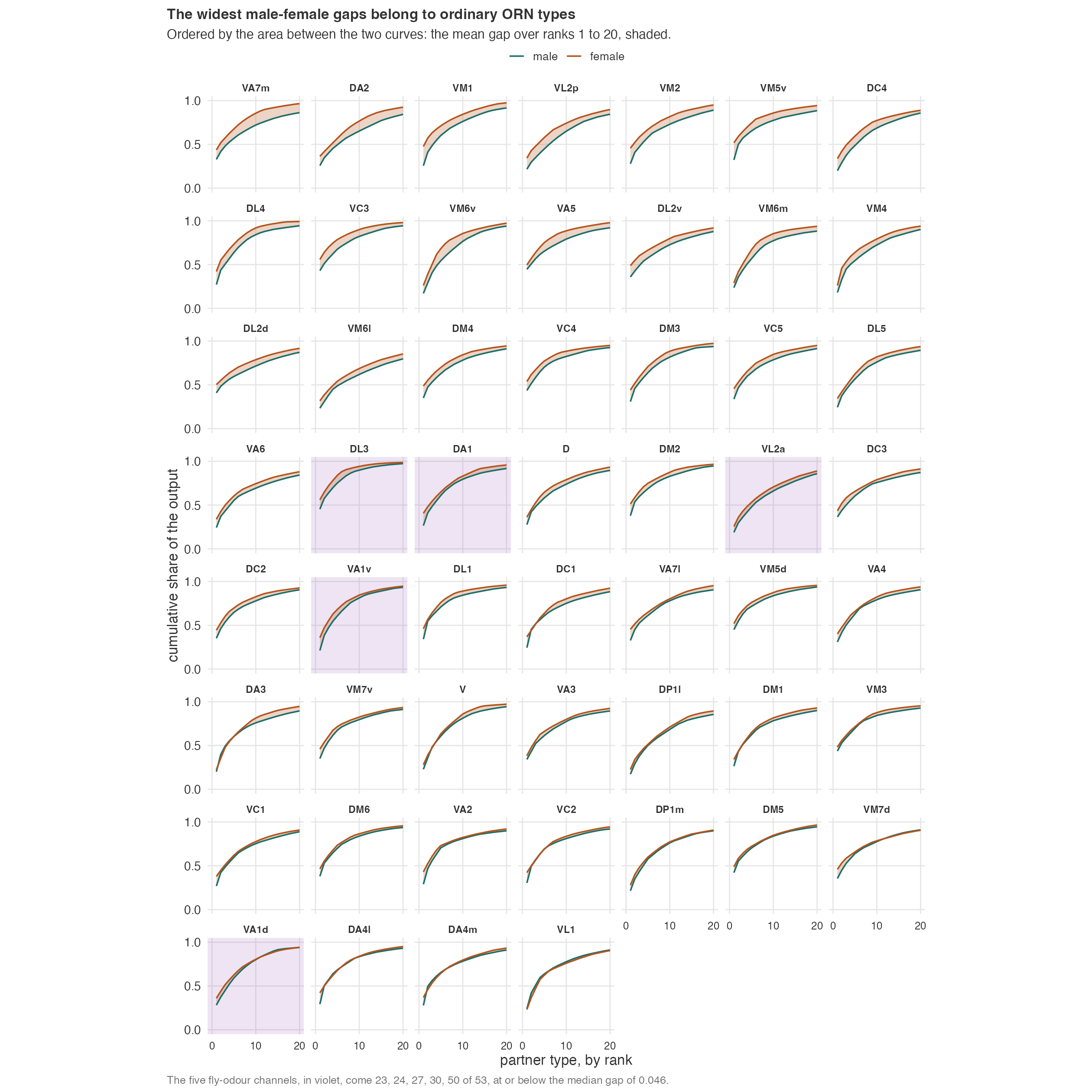
One rank abundance plot for each of the 53 ORN types, ordered by the area between the male and female curves.
One plot for each ORN type, ordered by the area between the male and the female curve, the mean gap over ranks 1 to 20, shaded. It asks where the two sexes spread the output differently. Not in the fly-odour channels. They come 23rd, 24th, 27th, 30th and 50th of 53, at or below the median gap of 0.046. The widest gaps belong to ordinary types: VA7m 0.117, DA2 0.096, VM1 0.094. Every type but one holds the female curve above the male; VL1 alone runs the other way, at −0.016.